
The Bernoulli problem illustrates how deep thinking and persistence have historically led to breakthroughs, and it raises a modern concern about AI reducing our need to think critically. To stay mentally sharp in an AI-driven world, it’s important to actively engage in thinking tasks—like taking your own notes, reading original material, and verifying AI outputs instead of blindly relying on them
While preparing for my talk on "How to Stand Out in an AI-Dominated World", I came across a fascinating story.
In June 1696, Johan Bernoulli, a Swiss mathematician, addressed the readers of a popular scientific journal with the following:
I, Johann Bernoulli, address the most brilliant mathematicians in the world. Nothing is more attractive to intelligent people than an honest, challenging problem, whose possible solution will bestow fame and remain as a lasting monument. [...] If someone communicates to me the solution of the proposed problem, I shall publicly declare him worthy of praise.
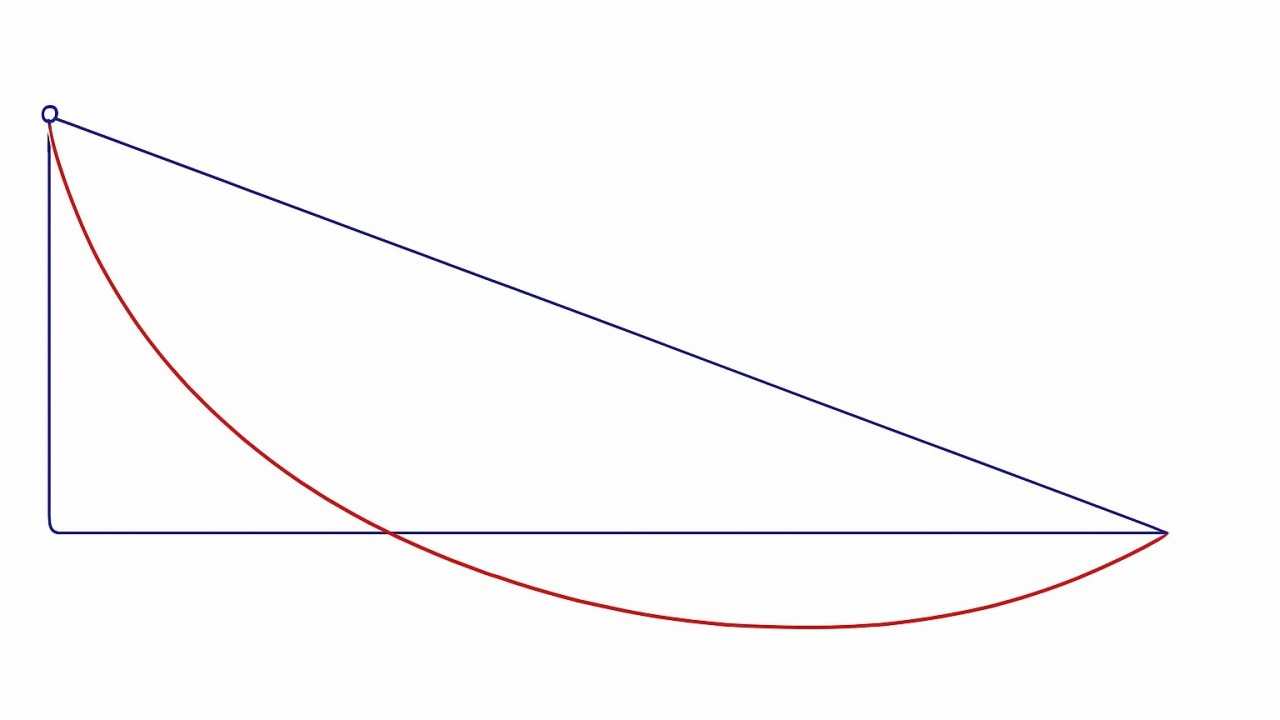
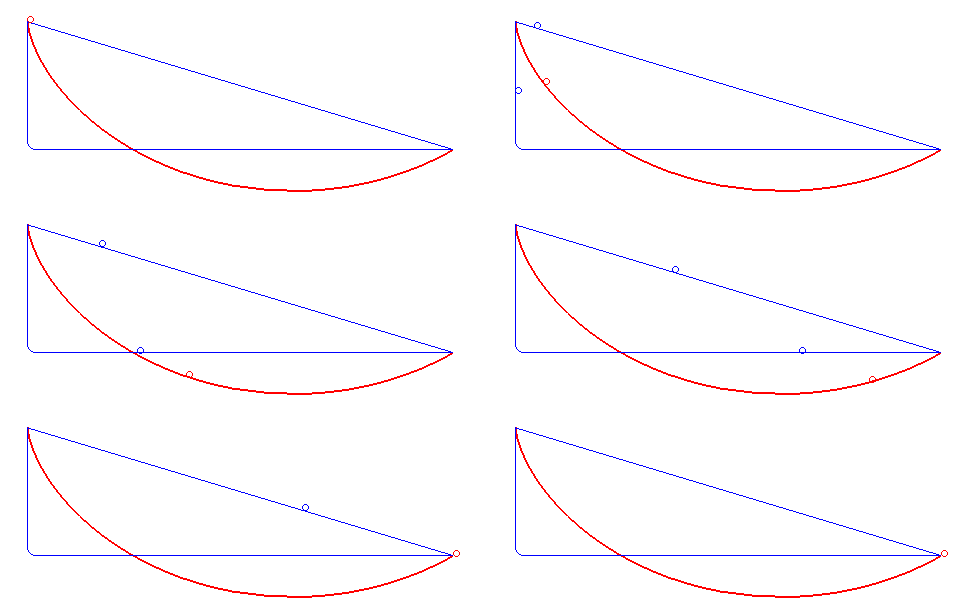
Bernoulli wanted to know what is the shortest path between two points, expressed in more mathematical terms as follows:
Given two points A and B in a vertical plane, what is the curve traced out by a point acted on only by gravity, which starts at A and reaches B in the shortest time.
Legend has it that Isaac Newton found the challenge in a letter from Johann Bernoulli when he came back home at 4 PM on January 29, 1697. He stayed up all night to solve it and mailed the solution anonymously the next morning.
Upon reading the solution, Bernoulli immediately recognized its author, exclaiming that he "recognizes a lion from his claw mark". Bernoulli himself had taken two weeks to solve the problem.
So, how does this relate to AI?
I've been seeing people rush to use AI at every opportunity, and this makes me sad.
The shortest path isn't always the fastest as Bernoulli proved. I'd add: it's not always the best either.
We still don’t know how AI will influence our ability to learn and think critically, but so far things aren't looking bright.
A study by Carnegie Mellon University and Microsoft showed that higher confidence in GenAI leads to less critical thinking, and that people with higher self-confidence tend to think more critically.
Cognitive offloading is tempting. Our brain accounts for about 20% of the body's energy consumption, despite only representing 2% of its weight.
So delegating thinking to AI feels good. However, it's not the best way to keep our brain in shape.
Brain cells operate under the same principle as muscles: use it or lose it.
If we stop exercising our mind and avoid mental effort, we won't be doing ourselves a favor.
Today, I'm sharing three things I do to avoid surrendering completely to AI.
Notetakers do a decent job summarizing the main points of a meeting, but I’m not relying on that.
I take notes during the meeting and summarize them afterwards. That exercise forces me to revisit the conversation and spot nuances an AI would never catch.
My routine: I let the notetaker run, then I write my own summary and compare to check for anything I might have missed
It keeps me alert during the call, listening for the unsaid and noticing the subtle vibes.
I hate it when Adobe PDF Reader shows that “View Summary” banner when I open a file.
If the topic matters to me, I want to read it.
Following the author’s reasoning helps me understand the message better than a shortcut ever could.
I’m old enough to remember when Wikipedia was one of the most visited websites in the world. I even contributed to some articles.
Some pages were solid references, but I always checked the citations.
I never believed something just because it was “on the internet.”
The same applies to AI. I don’t take everything an LLM spits out as truth. I check the sources behind its claims.
As AI takes on more of our work each day, I want to keep using my brain as much as I can. I hope you're after that too.
Fadi Boulos is the founder of Supportful, a software engineering consulting firm based out of Lebanon. He enables startups in the US and Europe to augment their teams with remote engineers from Lebanon, helping reduce the brain drain in the country and preserve the human capital of its small communities. Fadi has 20 years of experience working in the tech space in the UK, France, and Lebanon, and holds a Ph.D. in Computer Science from the University of Nantes, France.



Book a call and get matched with engineers in 24–72h.